
News & Events
Case Study | PCB Wet-Process Drying Retrofit
GALEX completes a first-phase drying retrofit at the China plant of a leading Austrian PCB manufacturer.
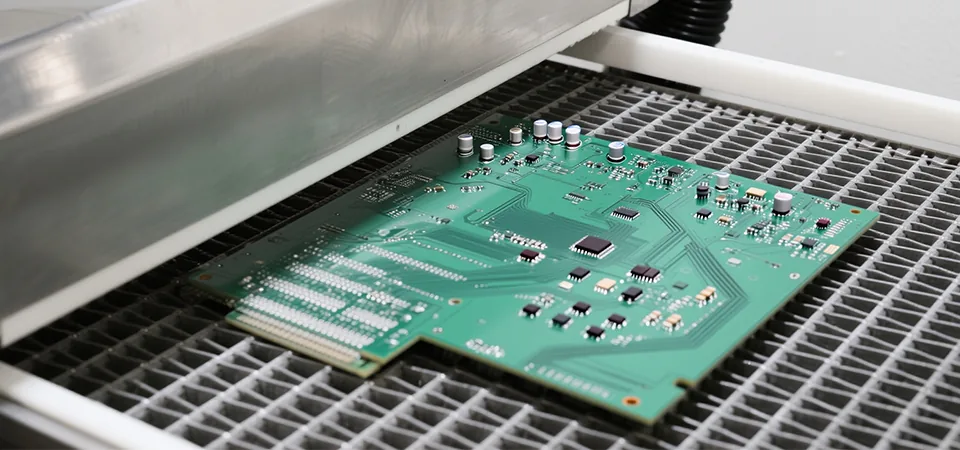
GALEX has completed the first phase of a drying-section retrofit at the China plant of a leading Austrian printed circuit board manufacturer. More than 100 high-speed turbo blowers have replaced side-channel blowers on wet-process horizontal lines. A second phase is planned.
On a PCB wet-process line, boards pass through etching, developing, stripping and micro-etching before high-pressure air knives dry the surface ahead of the next step. Side-channel blowers have long supplied the air for that stage.
Three factors drove the change. Side-channel blowers operate at a fixed duty point and cannot track what each process section actually needs. Drying requirements are not uniform, so one shared duty point means every section is served at the highest common demand. Wet-process lines also stop for batch and product changes, yet the previous blowers continued to run at full duty.
Each X7 unit is set for its own process section, with supply pressure held to within approximately 1 kPa of target. An I/O module connects the units to the existing line control system over dry-contact signals, while the plant's existing control logic and operator interface remain in place.
The units use ceramic ball bearings, allowing them to stop completely during production gaps instead of idling. Standby consumption falls to approximately 50 W, and a unit returns to its required duty point within two seconds of a demand signal.
Energy consumption across the drying sections has been reduced by more than 50 per cent against the previous side-channel blowers. Payback is estimated at approximately 7.5 months. Based on first-phase operating results, the plant has scheduled a second phase covering additional sections.